Which Action Camera to Buy in 2026: Stop Wasting Money on Hype
Most people searching for a 4K WiFi action camera end up buying garbage. Not because they’re stupid, but because the market is flooded with cheap Chinese clones that promise 4K and deliver pixelated mush. I’ve tested and torn apart enough of these cameras to know the difference between a real workhorse and a plastic toy that dies after three surf sessions.
Here’s the blunt truth: if you’re asking which action camera to buy, you don’t need the most expensive GoPro. You need a camera that matches your actual use case. Buying a €400 flagship to film your dog in the backyard is dumb. Buying a €35 piece of junk to film downhill MTB at 60 km/h is even dumber.
The 4K Lie: What “4K WiFi Action Camera” Actually Means in 2026
Any camera can slap “4K” on the box. Very few actually record native 4K at a usable frame rate. Real 4K means 3840×2160 pixels at minimum 30fps. If a spec sheet says 4K at 15fps, that’s interpolated garbage — it’ll look like a slideshow.
And “WiFi” on an action camera means one of two things: real WiFi that lets you preview and transfer files to your phone, or fake WiFi that only works with a crappy proprietary app nobody updates. I’d argue the app matters more than the WiFi chip itself. A great camera with a broken app is a paperweight.
For 2026, I’d say the sweet spot for a solid 4K WiFi action camera sits between €60 and €150. Below that, you’re gambling. Above that, you’re paying for brand tax unless you actually need 5K or 120fps slow motion.
Three Factors That Actually Matter (Ignore the Rest)
Forget the marketing noise. When deciding which action camera to buy, only three things will determine whether you regret your purchase in six months.
1. The Sensor and Chipset, Not the Megapixel Count
A 20MP label means nothing if the sensor is tiny and the processor is slow. Look for Sony IMX sensors when possible — they’re the ones that actually deliver clean footage in low light. The chipset matters too: Ambarella and Novatek are the real players. If a spec sheet doesn’t mention either, that’s a red flag.
My stance: don’t buy anything that doesn’t list its sensor model. If the manufacturer hides it, they’re hiding something worse.
2. Stabilization: EIS vs. Nothing
Electronic Image Stabilization (EIS) is non-negotiable for a 4K WiFi action camera in 2026. Without it, your footage looks like an earthquake documentary. Gyro-based EIS is what you want. Optical stabilization in action cams is rare and expensive — skip it unless you’re going pro.
Here’s the catch nobody mentions: EIS crops your footage. A 170° lens becomes effectively 130° when stabilization is active. If you need the full wide angle, you’ll have to disable EIS and shoot smooth handheld instead.
3. Battery Life Is a Joke on Every Camera
Every manufacturer lies about battery. A 1050mAh cell gives you roughly 60-80 minutes of real 4K recording, not the “2 hours” on the box. That’s why you should only buy cameras that ship with two batteries and ideally an external charger. One battery is a scam — it means you’ll be buying accessories the same day.
Budget Breakdown: What €35, €75, and €150 Actually Get You
Let me cut through the noise with real numbers based on what’s on the market right now.
- €35-50 range: You get 4K at 30fps (often interpolated), basic EIS that works only in 1080p, a 2-inch screen, and 30M waterproof case. Fine for casual vlogging, kids, or a backup camera.
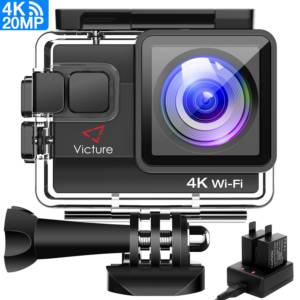
- €60-90 range: Real 4K at 30fps, functional EIS in 4K, 40M waterproof, remote control, external mic support. This is where the smart money goes for a 4K WiFi action camera.
- €100-150 range: 4K at 60fps, touchscreen, voice control, dual screens, 8x zoom. Worth it only if you’re editing professionally or filming fast action.
Anything over €200 without 5K or 120fps is brand worship, not smart buying.
Accessories You’ll Actually Need (and What’s a Waste)
Most kits ship with 20+ accessories. Half of them are useless plastic you’ll never touch. Here’s what matters:
- Waterproof case: Non-negotiable. Even “waterproof” cameras leak at depth without the case.
- Helmet and handlebar mounts: Essential for cycling, skiing, or motorcycling.
- Chest strap: The most underrated mount. Gives you POV footage that looks professional.
- External microphone: If audio matters (and it does for vlogging), skip anything without a mic port.
- Extra batteries: Buy at least two spares. Always.
What’s a waste? Suction cup mounts that fall off at speed, cheap tripods that wobble, and those ridiculous selfie sticks that snap in the wind.
GoPro vs. Cheap 4K WiFi Action Camera: The Honest Take
GoPro still wins on stabilization and low-light performance. That’s a fact. But a €70 camera with EIS gives you 85% of the GoPro experience for 20% of the price. Unless you’re filming professionally or in dark conditions, the gap doesn’t justify the cost.
Where cheap cameras fail: app reliability, firmware updates, and customer support. That’s the real cost of saving €300. If you can live with a buggy app, you’ll be fine.
My advice: if you film once a month, buy the cheap one. If you film weekly and your footage matters, spend the money. There’s no middle ground worth defending.
Final Word: Stop Overthinking, Start Filming
The best 4K WiFi action camera is the one you actually use. I’ve seen people with €500 setups who never leave the house and people with €50 cameras who produce content that goes viral. The gear matters less than the person holding it.
Pick a budget, check for native 4K, EIS, two batteries, and a waterproof case. That’s your checklist. Everything else is noise designed to make you spend more than you need.