
If you’re here, it’s because at some point you typed into Google something like “Yahoo Mail in Spanish log into my email account” and you ran into the same old thing: official pages that send you to generic links, tutorials that look like they were written by a robot, and a login screen that sometimes works and sometimes just keeps loading as if it had a mind of its own.
I’ve been using Yahoo Mail for years. I’m not a cybersecurity guru and I don’t work for Yahoo. I’m just a regular person who has been through every possible drama with this account. And I’m going to tell you what I’ve learned, no sugarcoating.
The correct URL and why most people get it wrong
The first mistake almost everyone makes is searching for “Yahoo Mail” on Google and clicking the first result. That takes you to the Yahoo homepage in Spanish, which is not the same thing as the mail.
The real gateway to Yahoo Mail in Spanish is mail.yahoo.com. Period. If you type that directly into the address bar, you save yourself the circus of menus, redirects, and intermediate pages that Yahoo has been piling up over the years.
Now, here comes the first nuance that nobody mentions. If your account ends in @yahoo.com, @ymail.com, or @rocketmail.com, just typing your username is enough. But if you created the account with a non-Yahoo email — for example, a Cox or Frontier account that migrated to Yahoo — you have to enter the full address. This is something Yahoo has changed several times and it still confuses a lot of people.
The login that gets stuck in a loop and the solution almost nobody tries
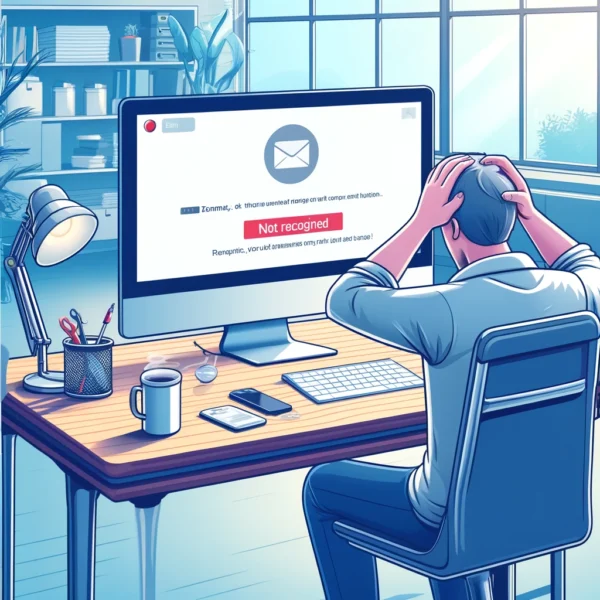
You’ve entered your username. You’ve entered your password. You hit “Sign in” and… the screen stays the same. Or worse: it asks you for the same thing again. Over and over. As if Yahoo had forgotten who you are within seconds.
This is a classic. And the cause is almost never your password. It’s the session cookie. Yahoo, for some reason only they know, sometimes gets stuck with the login cookie and enters an infinite loop.
The solution that has worked for me more times than I can count: on the login screen, look for the link that says “Not you?” Click there, re-enter your username and password, and it usually goes through on the first try. It sounds weird, but it works. It’s like giving the machine a kick so it remembers it exists.
If that doesn’t work, delete the Yahoo cookies in your browser. Only the Yahoo ones, not all of them. And restart the browser.
When the problem isn’t Yahoo, it’s your browser (and you don’t know it)
There’s something I’ve seen over and over again that people refuse to accept: the problem isn’t Yahoo, it’s Edge, Chrome, or whatever browser you use.
Let me explain. There are extensions — ad blockers, privacy tools, VPNs — that interfere with Yahoo’s login page. They literally block the script that makes the “Sign in” button work.
If you’ve tried on your phone and it works, but on your computer it doesn’t, the problem is your browser. Do the test: open an incognito window and try there. If it works in incognito, you already know the culprit is an extension or a corrupted cookie.
The second usual suspect is the browser profile. Sometimes profiles get corrupted and carry over settings that break login pages. Creating a new profile in Edge or Chrome usually solves the problem in two minutes.
The app password: that thing nobody explains properly
Let’s get into a topic that confuses a huge number of people and that Yahoo doesn’t explain clearly in Spanish. If you use a desktop email program — Outlook, Thunderbird, Apple Mail, whatever — or if you try to set up Yahoo in an app that isn’t the official Yahoo one, you’ll very likely need an “app password.”
What is that? It’s a long code you generate from your Yahoo account’s security settings. It’s not your normal password. It’s a specific password for that program. Without it, the program will give you an authentication error even if your normal password is correct.
This is especially important if you have two-step verification enabled. Yahoo blocks programs that use old security protocols and forces you to use app passwords.
The path to generate one: log into your Yahoo account from the browser → Account Security → App Passwords. There you create a new one, give it a name (“Outlook,” for example), and copy the code. That code is what you enter in the email program.
The 12-hour lockout that can save you or sink you
Yahoo has something very few people know about: if you fail the password several times in a row, the account gets temporarily locked. Twelve hours, to be exact.
I know what you’re thinking: “twelve hours is an eternity.” And you’re right. But there’s a way out. If you go to Yahoo’s sign-in helper and follow the recovery process, you can unlock it sooner.
Now, the important nuance: if you start seeing repeated lockouts without having failed the password, Yahoo is detecting something strange. It could be that your IP is constantly changing — a VPN, for example — or that someone has tried to log in from another location. In that case, the lockout isn’t an error, it’s a protection. And what you need to do is change your password and review your security settings.
The next time someone tells you that “typing your email into Yahoo is easy,” send them to read this. Because easy it is not. It is what it is.