

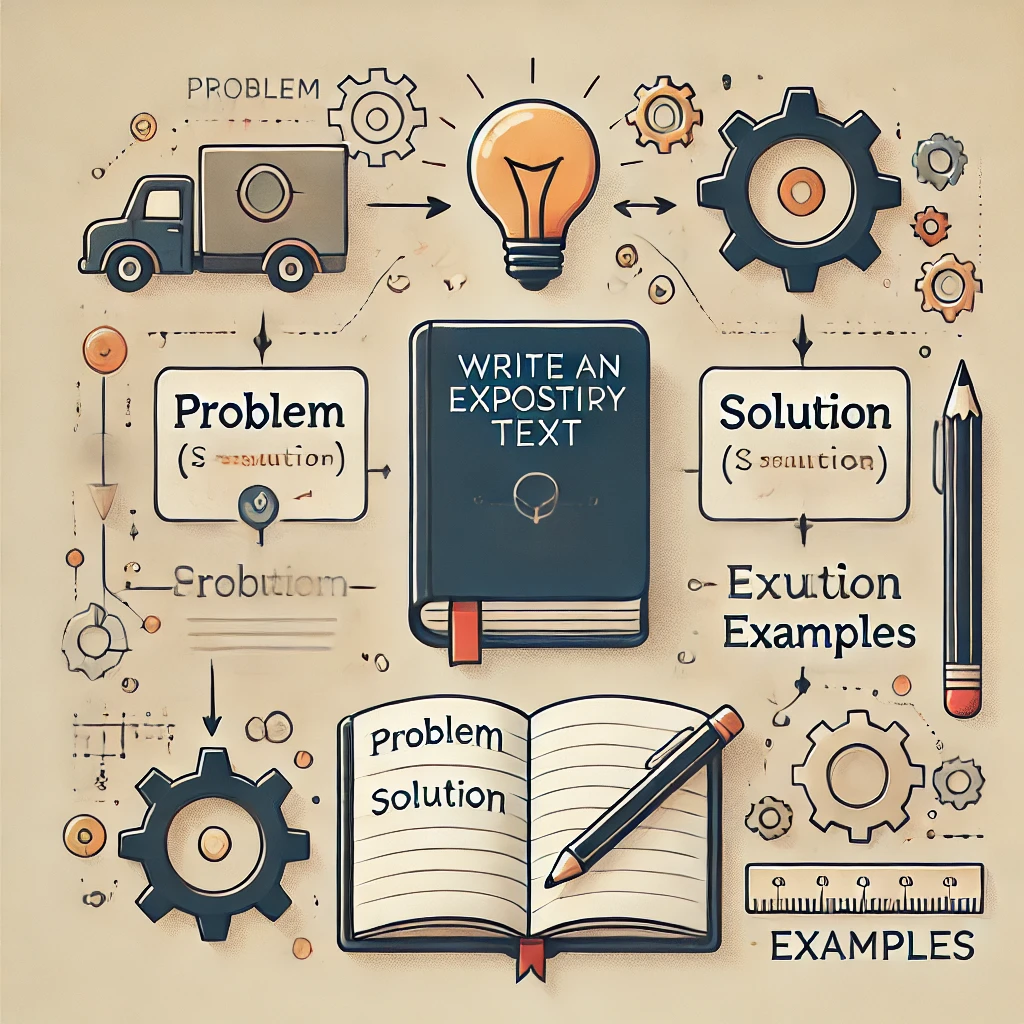
Most people who write expository texts fail for one simple reason: they explain a topic without ever giving the reader a reason to care. You can pile up facts, dates, and definitions, but if there’s no tension, no problem, no payoff, the reader bails by the third paragraph. The fix isn’t complicated. It’s the problem solution examples in expository text formula, and once you understand how it works, you can’t unsee it.
I’m not talking about a rigid school template. I’m talking about a way of thinking that real writers, journalists, and even advertisers use constantly, often without naming it. You pose a real difficulty, you show why it matters, you offer a concrete way out, and you prove it with something the reader can picture. That’s it. That’s the whole engine.
What the problem-solution pattern actually does to a reader’s brain
An expository text is supposed to inform, not to persuade you of an opinion. But informing without structure is just noise. The problem-solution pattern gives information a shape, and shape is what makes it stick.
When you open with a problem, you create a small gap in the reader’s head. Psychologists call it a curiosity gap, and it’s the same trick cliffhangers use. The brain hates an open loop. It wants closure. So when you present a well-defined problem, the reader keeps going because they need to see how it resolves.
This is why problem solution examples in expository text aren’t just a school exercise. They’re a readability tool. A text that states a problem clearly and then delivers a solution feels satisfying in a way that a flat list of facts never does.
The catch: the problem has to be sharp. Vague problems produce vague solutions. If you write «pollution is bad,» nobody feels anything. If you write «in 2024, Madrid exceeded EU air quality limits on 87 days, forcing schools to cancel outdoor sports,» now you have a problem with teeth.
How to write a problem that doesn’t put people to sleep
Three things make a problem land: specificity, stakes, and a human face.
Specificity means numbers, places, dates, names. Not «many cities,» but «Mexico City.» Not «recently,» but «in 2025.» The more concrete the problem, the more credible the text.
Stakes means the reader needs to know what happens if the problem isn’t solved. Loss of money, health, time, opportunity. Something has to be on the line.
A human face means connecting the abstract problem to a person. A farmer, a student, a business owner. Readers don’t empathize with statistics. They empathize with people who own the statistics.
A problem without stakes is just a complaint. A problem with stakes is a reason to keep reading.
You don’t need all three in every paragraph. But the opening of your expository text should hit at least two. Otherwise the reader has no reason to trust that what follows is worth their time.
Solutions: where most expository texts fall apart
Here’s the part people mess up. They present a big problem and then offer a solution so vague it means nothing. «We should do more.» «Awareness is key.» «Society needs to change.» These are not solutions. They’re placeholders.
A real solution has three components: it’s actionable, it’s feasible, and it has a cost. If your solution has no cost, you’re lying or you’re naive. Every real fix trades something: money, convenience, political capital, time.
Take the climate example. «Reduce emissions» is not a solution. It’s a goal. A solution looks like: «Germany’s 2023 shift to 52% renewable electricity was driven by a feed-in tariff scheme that paid homeowners for solar output, funded by a small surcharge on every electricity bill.» Now you have a mechanism, a scale, and a trade-off. That’s a solution.
The best problem solution examples in expository text always show the mechanism. Not just what should happen, but how it happens and who pays for it.
Examples are what turn claims into proof
You can describe a solution in perfect detail and still lose the reader if they can’t visualize it. Examples are the bridge between abstract argument and lived reality.
Good examples share one trait: they’re verifiable. If you cite a city, a study, or an event, someone should be able to look it up. That’s what separates an expository text from a puff piece.
- Real case studies work best when the problem and solution are both visible in the same story.
- Historical parallels work when the current problem echoes something already solved or failed.
- Hypothetical scenarios work only when the concept is too abstract for a real example, and even then, keep them short.
- Personal anecdotes can work in lighter expository writing, but they weaken formal texts unless tied to data.
One trap: stacking examples that say the same thing. Three cities that all cut emissions with solar panels don’t add depth. They add length. Each example should show a different angle of the problem or a different type of solution.
The structure that actually holds up under pressure
You don’t need a rigid five-paragraph formula, but you do need a spine. Here’s the one that works for almost any expository topic with a problem-solution angle:
- Open with the problem in concrete terms. One paragraph, no warm-up.
- Explain the context. Why does this problem exist? Who is affected?
- Introduce the solution with its mechanism. How does it work, and what does it cost?
- Back it with examples. At least two, showing different angles.
- Close with what’s still unresolved. No «in conclusion,» just a real observation.
That last point matters. Endings like «in summary, we have seen that…» are a death sentence. Instead, end with a tension that remains, a question the reader can carry, or a next step that someone could realistically take.
If you’re writing about urban heat islands, don’t finish with «we must act.» Finish with the fact that Medellín’s green corridor project cut local temperatures by 2°C in three years, but only along the corridors themselves, leaving most neighborhoods untouched. That’s honest. That’s useful. That’s the kind of ending that makes people remember your text.
Common mistakes that kill problem-solution texts
The biggest one is a mismatch in scale. You open with a global problem and offer a personal solution. «Climate change is an existential threat. So recycle more.» The reader feels the gap instantly, and credibility drops to zero.
Another is the false dichotomy. Presenting only two options when there are five. Readers notice, and they distrust writers who pretend complexity doesn’t exist.
A third is skipping the transition. Going from problem to solution without a linking sentence feels like a jump cut in a film. One line like «So what actually works?» or «The fixes that have moved the needle look nothing like the ones politicians usually propose» does the job.
And the last one: no evidence. If your solution has no data, no case study, no measurable outcome, it’s just an opinion wearing a suit. Expository writing lives or dies on evidence.
Why this pattern is dominating search in 2026
Search engines and AI answer systems now reward texts that solve a specific reader problem, not texts that vaguely cover a topic. A well-structured piece using problem solution examples in expository text hits every signal: clear structure, concrete data, cited examples, and a defined resolution.
That’s not a coincidence. Readers want answers, not overviews. If you write an expository text that poses a real problem, offers a workable solution, and proves it with examples that don’t insult the reader’s intelligence, you’re already ahead of 90% of what’s published.
The rest is just discipline. No filler. No vague promises. No conclusion that repeats what you already said. Just a problem worth caring about, a solution worth testing, and an example that makes it real.

