

In an ever-evolving digital world, SEO (Search Engine Optimization) is at the center of online marketing strategies. The rules of the game are changing rapidly thanks to innovative technologies like Google’s MUM algorithm, the incorporation of interactive content, and the increasingly rigorous focus on E-E-A-T (Experience, Expertise, Authority, Trust). Are you ready for the future of SEO? Here we tell you everything you need to know to keep your strategy up to date and effective. .
I recommend you check out this interesting article: What is Latent Search Demand?.
What is Google’s MUM algorithm and how will it impact SEO?
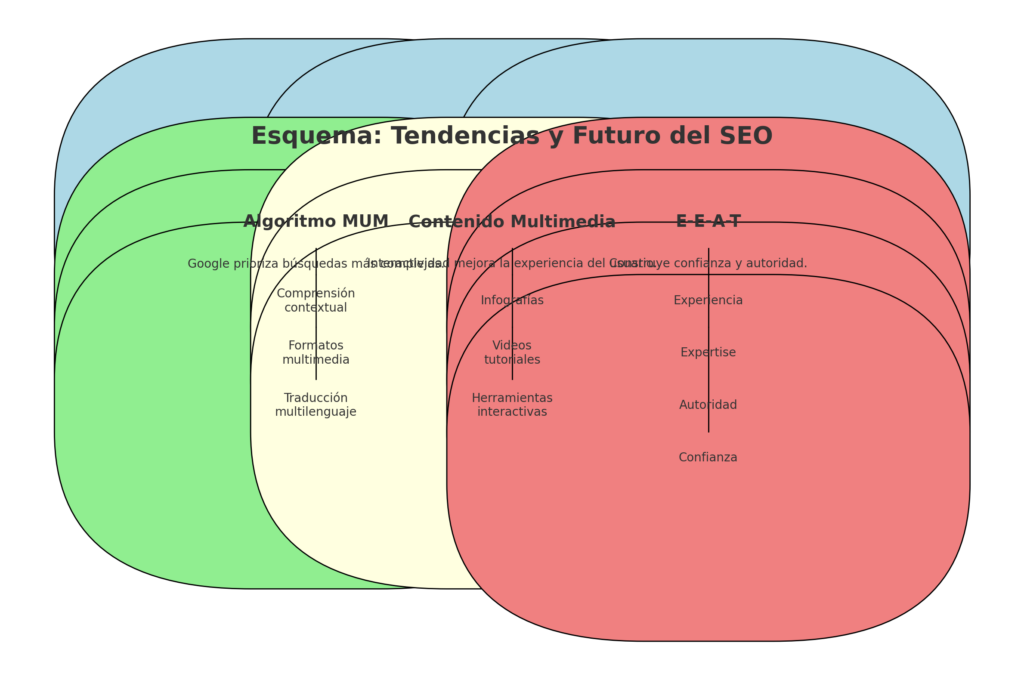
The MUM algorithm (Multitask Unified Model) is one of Google’s most advanced tools, designed to process complex searches more accurately. Its ability to understand languages, contexts, and content multimedia makes it a true paradigm shift in SEO. How does this affect Websites?
- MUM revolutionizes semantic search. While traditional algorithms focus on specific keywords, MUM has the ability to interpret the full context of a query, which forces content creators to focus more on user intent.
- It integrates content in multiple formats. This means that text, images, videos, and even audio can be relevant in search rankings, which highlights the importance of diversifying your content strategies.
- Real-time translation. MUM can interpret content in multiple languages, allowing relevant pages from around the world to compete for rankings, regardless of their original language.
- Create rich and varied content that directly answers complex questions.
- Use tools to analyze search intent in your niche.
- Optimize images and videos with accurate metadata and relevant alt text.
The importance of interactive multimedia content in the SEO of the future
Multimedia content is shifting from being a complement to becoming a central factor in advanced SEO. Google increasingly prioritizes enriching user experiences, and this includes explainer videos, interactive graphics, and dynamic tools that capture the visitor’s attention.
Why is interactive content key?
- It increases dwell time. A user who spends more time exploring interactive content on your site sends positive signals to search engines.
- It improves the user experience. An attractive and intuitive navigation reduces the bounce rate, which in turn improves your ranking.
- It boosts viral content. Shareable infographics and videos expand your brand’s reach, generating valuable backlinks.
Recommended formats:
- Animated infographics that explain complex concepts.
- Interactive tools, such as calculators or simulators.
- Video tutorials with SEO-optimized subtitles.
- Use descriptive titles and keywords in file names.
- Implement ALT tags for images and descriptions for videos.
- Compress files to ensure fast loading times.
E-E-A-T: How to meet Google’s new requirements
The concept of E-E-A-T (Experience, Expertise, Authority, Trust) is a fundamental pillar of modern SEO. Google evaluates these criteria to determine whether your content is worthy of trust and useful for users.
What does each element of E-E-A-T mean?
- Experience: Does your content reflect practical knowledge? Users seek authentic and relevant experiences.
- Expertise: The authors of your content must be perceived as experts on the topic.
- Authority: Does your site have recognition in its field? Backlinks and mentions from reputable sites are crucial.
- Trust: Site security, such as the use of HTTPS, and transparency in information are essential.
How to optimize for E-E-A-T?
- Make sure each article is signed by an author with verifiable experience.
- Include links to reliable sources to support your claims.
- Publish original content and avoid practices such as plagiarism or clickbait strategies.
- Improve the technical experience of the site, such as loading speed and mobile optimization.
Key phrases highlighted:
- “E-E-A-T is a standard that evaluates the quality and reliability of your content.”
- “A site that complies with E-E-A-T will be more competitive in Google searches.”
- “Focus on creating content that demonstrates expertise and authority in your field.”
Summary: Keys to mastering the SEO of the future
Although SEO is changing, its fundamental principles remain: quality content, user experience, and adaptation to new technologies.
- Learn to work with algorithms like MUM, which value context over keywords.
- Integrate interactive multimedia content to capture and retain audiences.
- Reinforce the principles of E-E-A-T to build trust and authority.
What’s next for you?
Start by auditing your website with these trends in mind and update your strategy. The SEO of the future won’t wait; act today.