

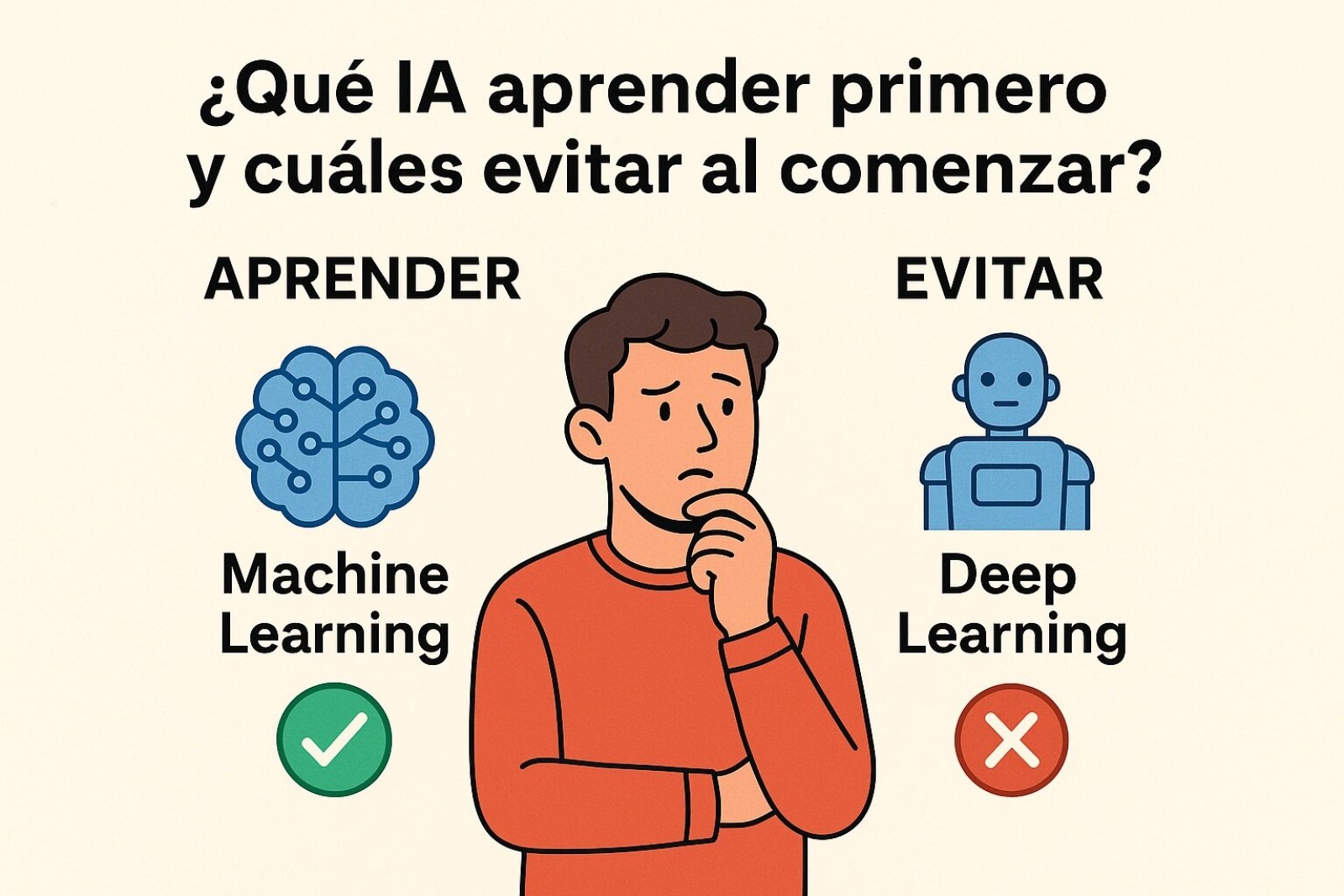
If you’re going to learn AI in 2026, here’s the uncomfortable truth nobody tells you: you don’t need a master’s degree, an expensive GPU, or a course on linear algebra. You need to open ChatGPT or Google Gemini and start talking to it. That’s it. That’s the whole first step.
The goal in your first two weeks is not to «understand AI» in the abstract. It’s to lose your fear of the blank chat box and figure out what a prompt actually is — the instruction you give the model. Ask it to plan your meals. Ask it to explain compound interest like you’re twelve. Ask it to rewrite that awkward email to your boss. The key to learning AI from scratch in 2026 is repetition through conversation, not theory.
What to Avoid When You’re Learning AI in 2026
Here’s where most beginners shoot themselves in the foot. They read one Reddit thread, get excited, and immediately try to install Stable Diffusion locally on a laptop with integrated graphics. Then they spend three weekends fighting CUDA errors and quit. Don’t be that person.
These are the traps that will kill your motivation before you even get started:
- Local image models like Stable Diffusion on your own machine. They need a decent GPU, command-line comfort, and patience for config hell. They teach you nothing about how AI actually works.
- APIs and automation platforms like Zapier with AI or n8n. These are tools for solving a specific business problem once you already understand the basics. Using them to «learn» is backward.
- Jumping straight into Python or calculus. The fastest way to give up on learning AI in 2026 is to start with math you have no reason to care about yet. Play with the tech first. The theory will make sense later, when you have a real problem it solves.
The Four-Phase Roadmap to Learning AI in 2026
Don’t skip phases. Each one builds on the last, and each one gives you a reason to keep going.
Phase 1: First Contact (Weeks 1–2)
Stick to ChatGPT, Gemini, and Copilot in their chat versions. Your only job is to have conversations. You need quick wins and muscle memory for how dialogue with an AI works. No APIs. No local models. No automation.
Phase 2: Creative Expansion (Weeks 3–4)
Now bring in image generation: DALL·E 3 through ChatGPT Plus or Midjourney. This phase teaches you to be specific and descriptive in your prompts, because image models punish vagueness instantly. Skip raw Stable Diffusion without an interface, and skip video gen models for now.
Phase 3: Everyday Integration (Month 2)
Pull AI into the tools you already use: Copilot inside Office and Google Workspace, Notion AI, Canva AI. You’ll see the practical value of AI in daily life without having to learn a new app from zero. Still no custom workflows.
Phase 4: Specialization (Month 3 onward)
By now you have judgment. Pick your lane: data analysis, development, audio, whatever. Now — and only now — you can tackle complex tools and actually get somewhere. Learning AI in 2026 with a real foundation beats learning it in a panic with none.
Two Uncomfortable Truths About Learning AI in 2026
AI lies. It’s called hallucination. Never trust a date, name, or citation without checking it.
The second truth: not everything sold as «AI» is AI. It’s the biggest buzzword of the decade, and plenty of companies slap it on basic if-then automations. Your compass should be what the tool actually lets you do, not the label on the box.
Here’s the thing though — hallucination isn’t a dealbreaker, it’s a workflow constraint. Treat the model like a brilliant, slightly overconfident intern. Useful for drafts, dangerous for facts.
The Only Skill That Actually Matters: Prompt Writing
Mastering AI in 2026 is mastering the art of giving instructions. Vague prompt, vague result. That’s the whole game.
- Bad: «Make a study plan.»
- Acceptable: «Make a study plan to learn AI fundamentals in a month.»
- Good: «I’m a marketing manager with zero technical background. Build me a 4-week plan to understand how generative AI works and apply it to my job. Weekly objectives, Spanish resources, max 5 hours per week. Output as a table.»
The difference is context (who you are), detail (exactly what you want), and format (how you want it delivered). Add layers of information to every request and watch the quality jump.
If all of this already sounds like too much, ignore 90% of it. Just open ChatGPT or Gemini today and start a conversation. The rest is noise until you take that first step toward learning AI in 2026.
