SEO is not dying. It’s just getting harder to fake. If your strategy in 2026 still revolves around stuffing keywords and buying sketchy backlinks, you’re already invisible to Google’s MUM algorithm.
The game changed. And most people didn’t notice until their traffic tanked.
What the MUM Algorithm Actually Changes (And Why It Kills Lazy Content)
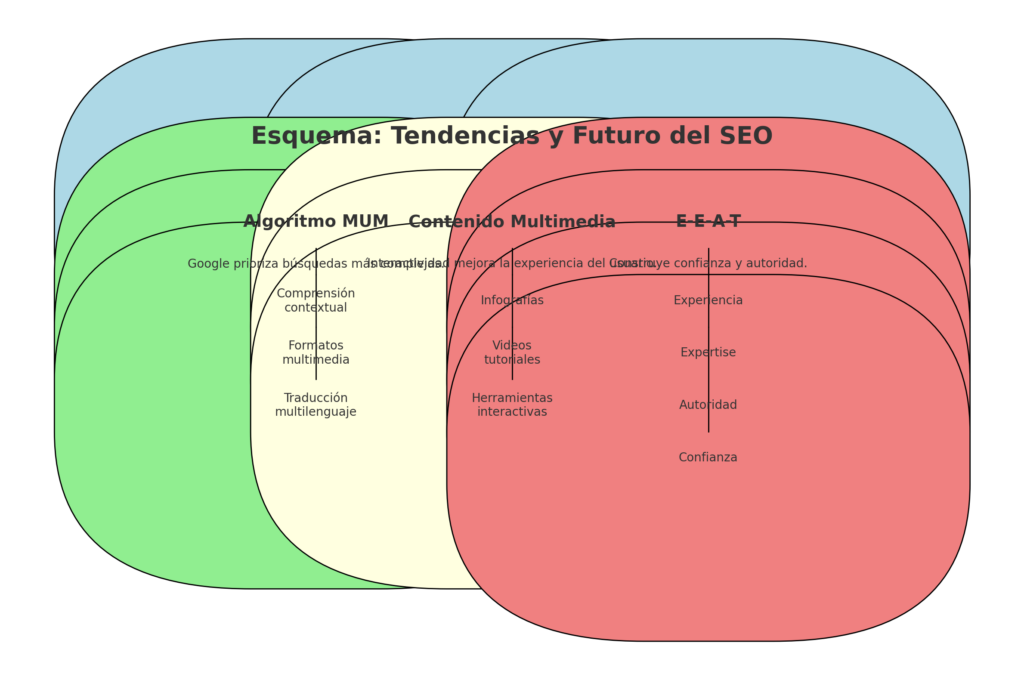
Google’s MUM (Multitask Unified Model) isn’t just another update. It’s a 1,000x more powerful language model than BERT, and it processes information across 75 languages simultaneously. That’s not marketing fluff — that’s from Google’s own research.
Here’s what nobody tells you: MUM doesn’t care about your keyword density. It cares about whether your content answers the actual question behind the question.
Someone types «hiking Mt Fuji with kids» — traditional SEO would serve pages about Mt Fuji. MUM understands you need: difficulty level for children, gear recommendations, best season for families, and altitude sickness risks for young hikers. All from one query.
SEO trends 2026 demand that your content anticipates follow-up questions before the user even asks them.
What to do about it:
- Stop writing 500-word posts that barely scratch the surface. Go deep or go home.
- Map out the entire conversation around your topic — not just the head keyword.
- Use tools like AlsoAsked or AnswerThePublic to find the questions MUM expects you to answer.
Interactive Content Is No Longer Optional — It’s a Ranking Factor
Google’s Helpful Content system (fully integrated into the core algorithm since 2023) rewards pages that keep people engaged. And nothing keeps people engaged like content they can do something with.
Dwell time matters. Not as a direct ranking signal — Google’s Gary Illyes has been clear about that — but as a behavioral proxy that influences how Google evaluates your page’s value.
Think about it: if someone lands on your page, plays with a calculator, watches a tutorial, and scrolls through an interactive infographic for 4 minutes, Google notices. If they bounce in 8 seconds, Google notices that too.
Formats that actually work in 2026
- Interactive calculators — mortgage tools, ROI estimators, calorie counters. These generate backlinks naturally.
- Video with optimized captions — Google indexes the transcript. Free SEO real estate.
- Animated infographics — shareable, embeddable, and they earn links without you begging.
One caveat: don’t bolt on a gimmicky quiz just to tick a box. If it doesn’t serve the user’s intent, it hurts more than helps.
E-E-A-T: The Standard Google Uses to Decide If You Deserve Traffic
E-E-A-T stands for Experience, Expertise, Authoritativeness, and Trustworthiness. It’s not a direct ranking factor — it’s a framework Google’s quality raters use. But those ratings train the algorithm.
E-E-A-T is the standard that evaluates the quality and reliability of your content, and ignoring it is the fastest way to lose rankings in 2026.
Here’s the breakdown that actually matters:
- Experience — Have you actually done the thing you’re writing about? First-hand experience beats theoretical knowledge every time. A personal trainer writing about deadlift form outranks a content farm regurgitating studies.
- Expertise — Credentials matter, but demonstrated knowledge matters more. Show your work.
- Authoritativeness — Who links to you? Who cites you? Who interviews you? Authority is earned, not bought.
- Trustworthiness — HTTPS, clear contact info, transparent sourcing, no deceptive ads. This is the foundation. Without trust, the other three mean nothing.
How to actually optimize for E-E-A-T
Real author bios with real credentials. Not «Admin» or «Team.» If your writers don’t have verifiable experience, either get new writers or get transparent about your editorial process.
Cite primary sources. Link to peer-reviewed studies, official documentation, government data. Not other blog posts.
Kill the clickbait. Google’s algorithms now detect when a title overpromises and the content underdelivers. That’s a trust violation.
A site that complies with E-E-A-T will be more competitive in Google searches — not because Google rewards the checklist, but because users reward the substance.
The Silent Shift: Multilingual Competition Is Coming for Your Rankings
MUM translates and understands content across 75 languages. That means a Spanish-language page with better information can outrank your English page for an English query.
Most SEOs aren’t ready for this. They still think language is a barrier. MUM treats it as a feature.
If you operate in a niche where non-English sources have deeper expertise — think traditional crafts, regional cuisine, local law — you’re competing globally now. Whether you like it or not.
The play: either become the definitive English-language resource through sheer depth, or build multilingual content that captures both audiences.
What to Audit Right Now (Not Tomorrow)
Open your site and ask these questions:
- Does every article answer the full question, or just the headline?
- Are your images and videos properly tagged with descriptive metadata and alt text?
- Can a user tell who wrote this and why they should trust them?
- Is there anything interactive, or is it all walls of text?
- Do you have content in more than one language, or are you leaving rankings on the table?
SEO trends 2026 aren’t about chasing algorithm updates. They’re about building something that deserves to rank. MUM, E-E-A-T, interactive content — these aren’t separate strategies. They’re the same principle: be genuinely useful or be ignored.
The sites that understand this are already pulling ahead. The ones still optimizing for 2019 are wondering why their traffic vanished.
Focus on creating content that demonstrates expertise and authority in your field. Not because Google says so, but because that’s what people actually want. Google just got better at measuring it.