

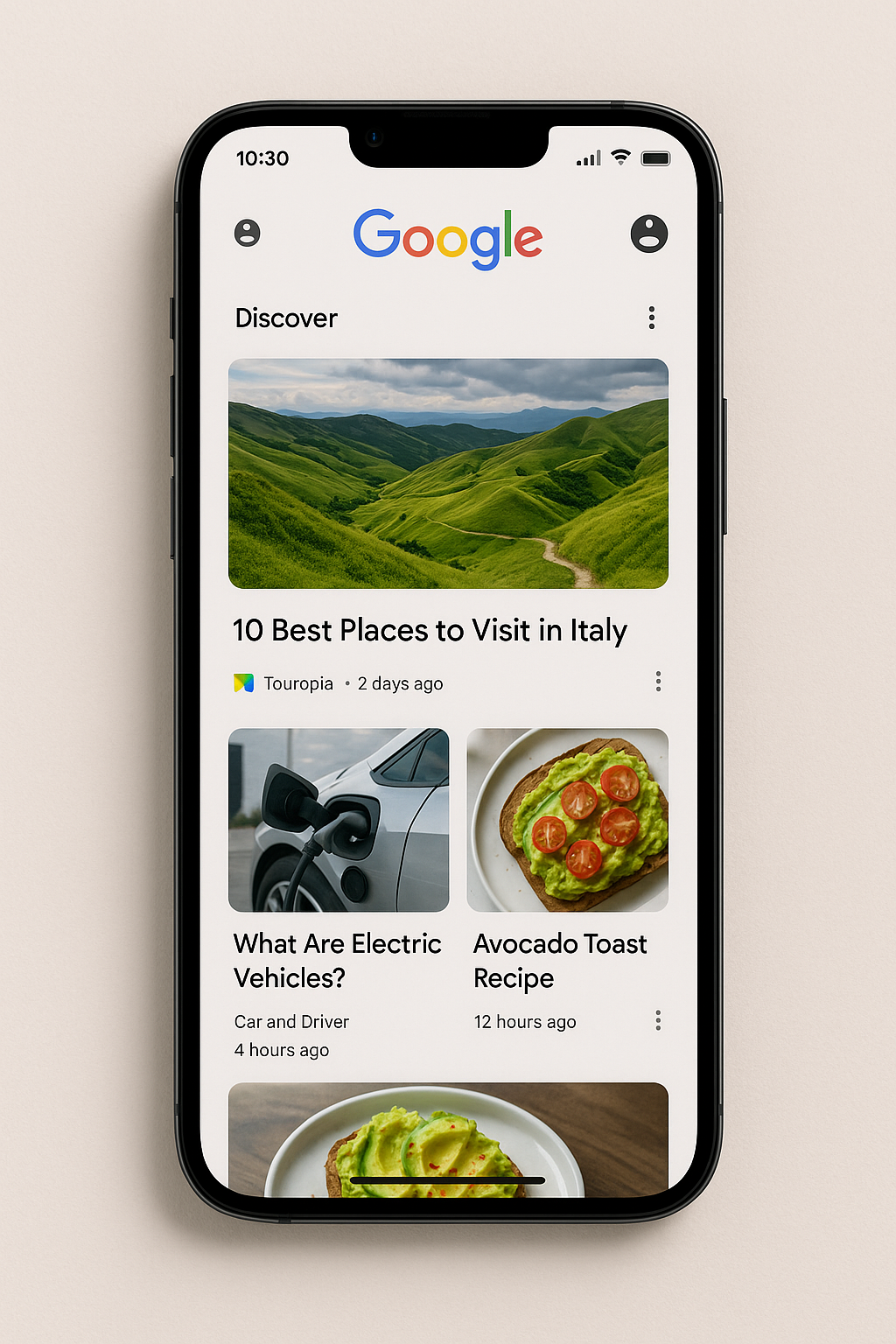
Forget everything you’ve heard about needing thousands of followers or a fat ad budget. Google Discover is the single biggest free traffic source in 2026, and it plays by completely different rules than classic search. I’m going to explain how to appear on Google Discover the way I’d tell a friend over WhatsApp: no jargon, no fluff, no guru nonsense.
Discover is that feed inside the Google app on your phone, the one that pops up when you swipe left on your Android home screen or open the Google app on iOS. Nobody types anything. Content just appears. If your article lands there, visits explode overnight without you paying a cent.
What Google Discover Actually Is (and Why It’s Not Search)
Search rewards people who already know what they want. Discover rewards curiosity. The algorithm builds a personalized feed based on each user’s browsing history, location, interests, and even the time of day. That means the Google Discover algorithm doesn’t care about your domain authority the way classic search does — it cares about whether your content matches a live interest signal.
I’ve seen brand-new blogs with zero backlinks pull 200,000 visits in a week from Discover. I’ve also seen big sites get ignored for months. The difference is almost never technical perfection. It’s relevance plus a strong visual hook.
Discover is a recommendation engine, not a search engine. Stop optimizing for keywords first and start optimizing for interest first.
1. Write About What Real People Are Actually Obsessed With Today
Boring explainer articles like «what is WiFi» will never trend. Nobody wakes up wanting to read that. But «why is my internet slow if I pay for 300 MB» gets clicks because it hits a real frustration people are living with right now.
The formula that keeps working for Google Discover optimization is simple: personal story + useful tip + a bit of curiosity. Not clickbait. Real experience. Talk about the problem you personally solved, how you solved it, and what went wrong along the way.
Check Google Trends every morning. If something is spiking in your country right now, that’s your window. Discover heavily favors timely content — a tutorial published the same day an app breaks will outperform the same tutorial published a month later by a mile.
2. Images Are Half the Battle (Literally)
Discover is visual. It looks more like Instagram than a search results page. Your featured image needs to be at least 1200 pixels wide, sharp, and free of watermarks or text overlays that look spammy.
Here’s the technical bit most people skip: you need to tell Google it can use a large preview. Drop this tag inside the <head> of your site:
<meta name=»robots» content=»max-image-preview:large»>
Without that tag, Google will often show a tiny thumbnail or skip your image entirely. I’ve tested this on two sites with identical content — the one with the tag got roughly 3x more Discover impressions. That single line of HTML matters more than most SEO plugins will admit.
3. Ditch Cheap Clickbait, Keep the Curiosity
Phrases like «you won’t believe what happened next» or «do this and Google will pay you» get filtered. Google’s spam systems got very good at this. What still works is honest provocation.
Compare these two titles:
- ❌ «You won’t believe how this blogger went viral»
- ✅ «How I appeared on Google Discover without being famous or having followers»
The second one is specific, believable, and promises a concrete outcome. That’s the tone that survives the Google Discover content policy filters and still gets tapped.
4. Mobile Speed Is Non-Negotiable
Discover only exists on mobile. If your site loads in 6 seconds on a phone, you’re done before you start. Google won’t push slow pages into a feed where users swipe past in half a second.
Run your URL through PageSpeed Insights and target a mobile score above 80. Kill intrusive interstitials, giant hero videos that autoplay, and anything that shifts the layout while loading. Use responsive images with proper width and height attributes so the page doesn’t jump.
Also — AMP is not required. Google dropped that requirement years ago, and in 2026 standard responsive HTML performs just as well if it’s fast.
5. Publish Consistently, Not Once and Pray
One viral post doesn’t build a Discover presence. The system needs to trust that your site produces fresh, relevant content regularly. Think of it as planting seeds: you publish consistently, and one day one of them explodes.
A realistic cadence for getting traffic from Google Discover is two to four quality posts per week, each tied to something current. Quality still matters — thin AI-spun filler gets ignored even if you publish daily.
6. Write Like a Human, Because You Are One
Discover rewards voice. Anecdotes, opinions, mild humor, even emojis — all of that helps. Not because Google has a sense of humor, but because engagement metrics (clicks, dwell time, returns to the feed) are what tell the algorithm your content pleased the reader.
If your article reads like a corporate press release, people bounce in three seconds and Discover learns to stop showing you. If it reads like a friend explaining something they actually figured out, people stay. That’s the whole game.
How to Check If You’re Already on Discover
Open Google Search Console, go to Performance, and look for the «Discover» tab in the top navigation. If it shows impressions, you’re already in. If it’s empty, you’re not yet — but that’s fixable.
Pay attention to which pages get Discover impressions and double down on that topic and format. Discover traffic is volatile — a post can spike for 48 hours and die — but the pattern of what works is learnable.
Common Mistakes That Kill Discover Traffic
- Using the same generic thumbnail on every post
- Publishing content that’s already outdated by the time it’s live
- Blocking Googlebot-Image in robots.txt by accident
- Hiding the publish date (Discover loves fresh timestamps)
- Ignoring the mobile experience because your desktop looks fine
Fix those five and you’re already ahead of 90% of bloggers who wonder why their articles never show up in that swipe-left feed.
The honest truth: nobody controls Discover. You can’t buy your way in, and you can’t guarantee a viral hit. But you can stack the odds — current topics, big clean images, fast mobile pages, real human writing, and that max-image-preview:large tag. Do that consistently for a few months and the feed will eventually find you.
