

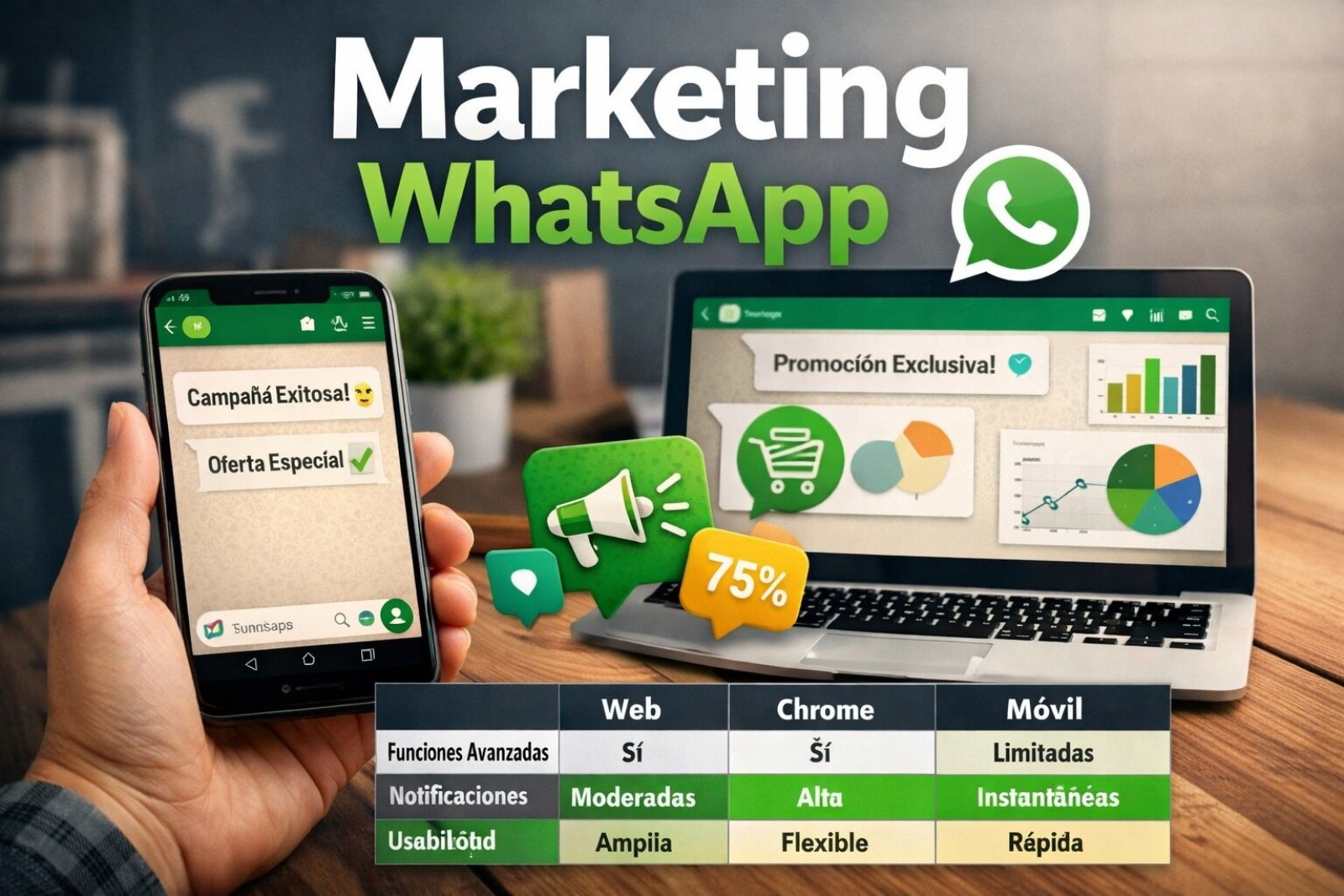
It works, and well. But it’s not magic; if you use it wrong, people will block you instantly.
The key is that almost everyone opens WhatsApp messages (around 98% ), while most marketing emails don’t even get opened (only 20% ). Think about your inbox full of promotions, compared to your WhatsApp, where you read almost everything. That’s the difference.
To sell, don’t treat it like a loudspeaker to shout offers. Treat it like the personal chat it is.
Here’s what you do:
- Choose the right tool from the start. If you’re an entrepreneur or have a small store, start with the free WhatsApp Business app. It lets you create a profile with your logo, hours, and a basic product catalog. But it has a limit: you can only send manual messages to 256 contacts at a time, and you can’t automate much. If you want to grow, sooner or later you’ll need the WhatsApp Business API. This isn’t an app you download, it’s a platform that connects to management programs (CRM). With it you can automate messages, provide 24/7 chatbot support, and send campaigns to thousands of people at once. Meta (WhatsApp’s owner) charges for this, around $0.043 per message in Mexico or €0.05 in Spain, but the performance is usually worth it.
- Get permission ALWAYS. This is the most important step and the one everyone wants to skip. You can’t add people to your lists just because you have their number. You have to explicitly ask them to agree to receive your messages (this is called “opt-in”). A simple method is to put on your website or social media: “Want exclusive offers via WhatsApp? Text ‘YES’ to this number.” Without that permission, your messages are spam and you risk fines.
- Send things people WANT to receive. Forget “BUY NOW!”. Think about useful messages:
- For those who leave something in your online store’s cart: An automatic reminder with a photo of the product and a link to complete the purchase.
- For those who already bought: A confirmation message, then another when the order ships, and another with the tracking number. This builds enormous trust.
- For your frequent customers: An exclusive offer you don’t publish anywhere else, like “Just for you this week, 15% off”.
- Visual content: Use carousel messages to show several products together, or send a short video showing how something is used.
- Automate the boring stuff and be fast with what matters. Use a chatbot for the basics: greeting, answering frequently asked questions (prices, hours, location), and capturing data. That way, if a customer writes at 11 at night, they’re not left ignored. But when someone asks “do you have size 42?”, make sure a human (or a well-configured bot) responds instantly. Speed is everything here; if you respond slowly, you lose the advantage.
- Talk like a person, not like an ad. The tone should be friendly, warm. Use the person’s name if you can (“Hi María, your order is on its way”). Don’t be afraid to use emojis ?, but in moderation. It’s the same app where people talk to their friends, so it sounds fake if you’re too formal or corporate.
Here’s what you DON’T do:
- Send mass messages left and right. Don’t bombard. An online store can send between 5 and 10 promotional messages a week at most; a B2B business, between 3 and 7.
- Ignore replies. The whole point is that it’s a conversation. If someone replies to your campaign, answer. If you can’t handle all the replies manually, that’s why you need a chatbot or a team.
- Forget to sell on other sites. Put the link to your WhatsApp everywhere: on your Instagram profile, on your website, in your email signature. Make it easy for people to find you there.
Real examples: a kitchen in Istanbul sells all its daily dishes just by posting the photo in a WhatsApp group and taking orders there. A chain of shoe stores in Mexico sent Christmas campaigns via WhatsApp and saw a 20% increase in traffic to their website. It works for the big and the small.
Start with the Business app, get permissions, and send a single useful message to a small group of customers who have told you yes. You’ll see how they react.