

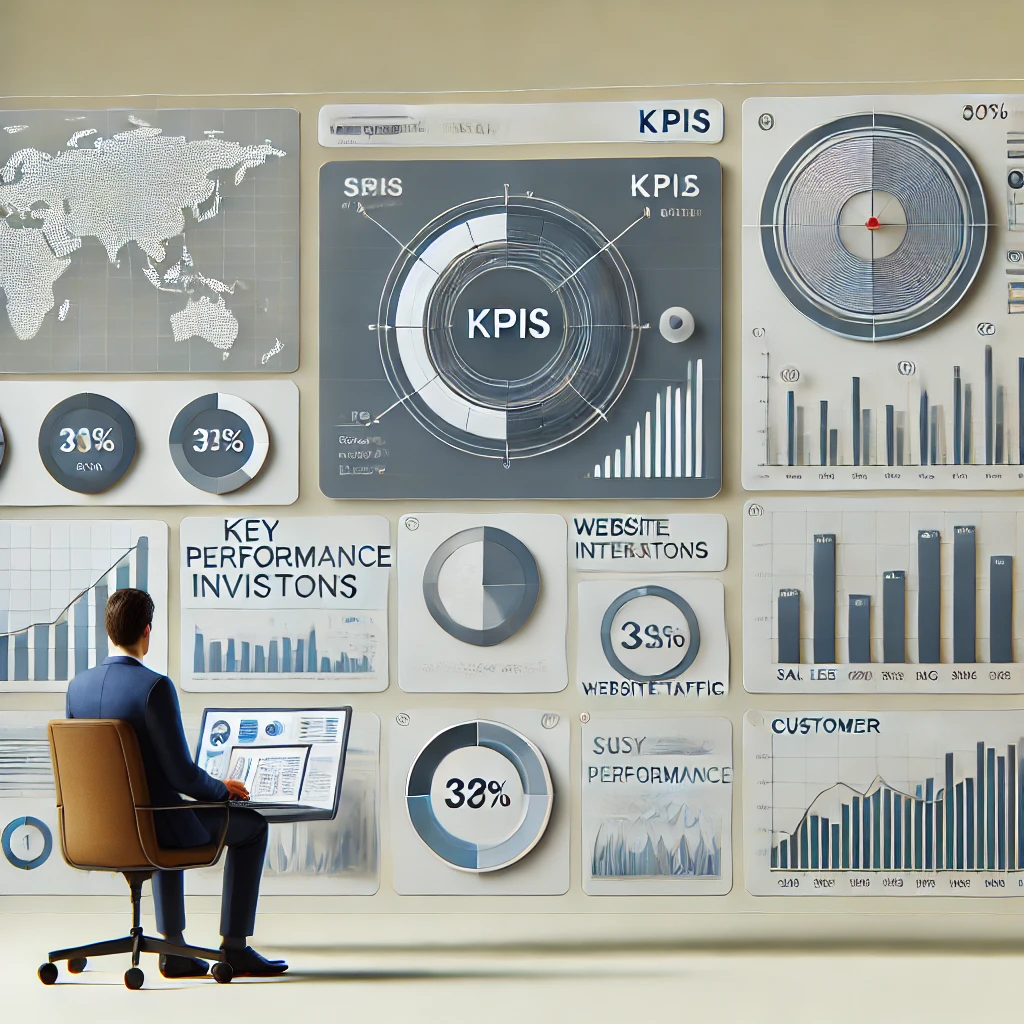
What is a KPI? A KPI, or Key Performance Indicator, is a key indicator of performance that measures progress toward a specific goal. KPIs help companies evaluate whether their <a href=”https://www.empresadeserviciosweb.com/con-una-buena-<a href="https://www.empresadeserviciosweb.com/youtube-strategy-ingresos-reales-monetizacion-videos-guia-practica/” title=”YouTube + strategy = real income 💼 Here I show you how 💸”>strategy–SEO-your-business-in-barcelona-can-grow-exponentially/” title=”SEO in Barcelona: strategies to grow your business and improve your web positioning”>strategies are working and make informed decisions. .
KPIs are essential because they act as compasses for any organization, since they allow you to measure whether efforts are truly heading toward the established objectives. These metrics are customizable according to the company and its goals, so <a href=”https://www.empresadeserviciosweb.com/post/guia-completa-como-<a href="https://www.empresadeserviciosweb.com/guia-completa-como-identifying–defining-and-leveraging-keywords-for-your-seo-strategy/” title=”Complete guide: How to identify, define, and leverage keywords for your SEO strategy”>identify-definir-y-aprovechar-las-palabras-clave-para-tu-estrategia-seo/” title=”Complete guide: How to identify, define, and leverage keywords for your SEO strategy”>identifying the right KPIs is essential. It is not about accumulating numbers, but about focusing on the <a href="https://www.empresadeserviciosweb.com/que-significado-tienen-las-kpis-en-el-mundo-del-marketing/" title="KPIs in digital marketing: what they are, main indicators and how to use them to boost your business”>indicators that truly influence performance.
importance of KPIs in business decision-making
The true function of a KPI is to provide clarity when making decisions. Measuring success without specific parameters <a href="https://www.empresadeserviciosweb.com/google-panda-penaliza-contenido-baja-calidad/" title="Does Google Panda affect all types of content or only some specific ones?”>is ambiguous, but KPIs provide concrete and measurable data. For example:
- If an online store wants to increase its sales, a useful KPI would be measuring the conversion rate.
- A marketing company can use the number of leads generated monthly as a KPI.
In both cases, tracking these indicators reveals patterns, strengths, and areas for improvement, facilitating more precise strategic decisions.
Furthermore, KPIs foster accountability within the team. By establishing clear and measurable objectives, each department knows what is expected of it and how its performance contributes to overall success.
On the other hand, using custom KPIs allows businesses to adapt quickly to market changes. If a strategy is not working, the indicators will show early signs, preventing unnecessary losses.
How to select the most relevant KPIs for your business?
Not all KPIs are relevant for all companies. Selecting the right ones depends on the specific objectives and the nature of the business. Here is a simple guide:
- Define clear and achievable objectives. Before establishing KPIs, you need to be clear about what you want to achieve.
- Align KPIs with your strategy. For example, if your goal is to improve customer service, your KPI could be response time.
- Use quantifiable metrics. KPIs must be measurable and specific. It is not enough to “improve sales”; you need to define “increase sales by 10% in 3 months.”
- Prioritize essential KPIs. Avoid overwhelming yourself with too many metrics. Focus on the ones that truly have an impact.
- Constantly evaluate and adjust. Needs change, and your KPIs can evolve too.
Choosing your KPIs well will give you a precise and measurable focus on your progress.
Key benefits of using KPIs in your organization
Implementing KPIs in your business management strategy has tangible and intangible benefits. Below, we highlight the most important ones:
- Effective performance measurement: With clear indicators, you can see your team’s progress and detect areas for improvement.
- Resource optimization: By focusing on essential KPIs, you reduce effort on tasks that do not add value.
- Facilitates communication and alignment: Employees better understand their objectives and how their efforts affect the whole.
- Informed decision-making: The data provided by KPIs eliminates guesswork, leading to strategies based on concrete facts.
- Adaptability and agility: Metrics reveal problems early, allowing actions to be adjusted quickly.
In summary, using KPIs in your company improves focus, productivity, and decision-making, allowing you to achieve more effective results in less time.
Practical examples of KPIs by type of business
KPIs vary by sector and goals. Here are some specific examples:
- Marketing:
- Conversion rate.
- ROI of advertising campaigns.
- Customer Acquisition Cost (CAC).
- Sales:
- Monthly revenue.
- Average Order Value (AOV).
- Customer growth rate.
- Customer Service:
- Average response time.
- Customer Satisfaction Score (CSAT).
- First contact resolution rate.
- Production:
- Process efficiency.
- Operating costs.
- Order delivery time.
By identifying which KPIs apply to your business, you can evaluate and improve the performance of each area.
Common mistakes when working with KPIs and how to avoid them
Although KPIs are powerful tools, many companies make mistakes when implementing them. The most common ones are:
- Choosing too many KPIs: Overloading your team with too many indicators creates confusion. Prioritize the most relevant ones.
- Not defining clear goals: Without a specific objective, measuring success with KPIs becomes useless.
- Not reviewing or adjusting KPIs: If you don’t analyze the results periodically, you won’t take advantage of the data obtained.
- Ignoring strategic alignment: KPIs must be in tune with the business objectives.
- Focusing only on negative data: KPIs also show achievements, not just problems. Recognize progress and celebrate improvements.
To avoid these mistakes, precisely define your KPIs, review them constantly, and make sure they are useful for your company.