
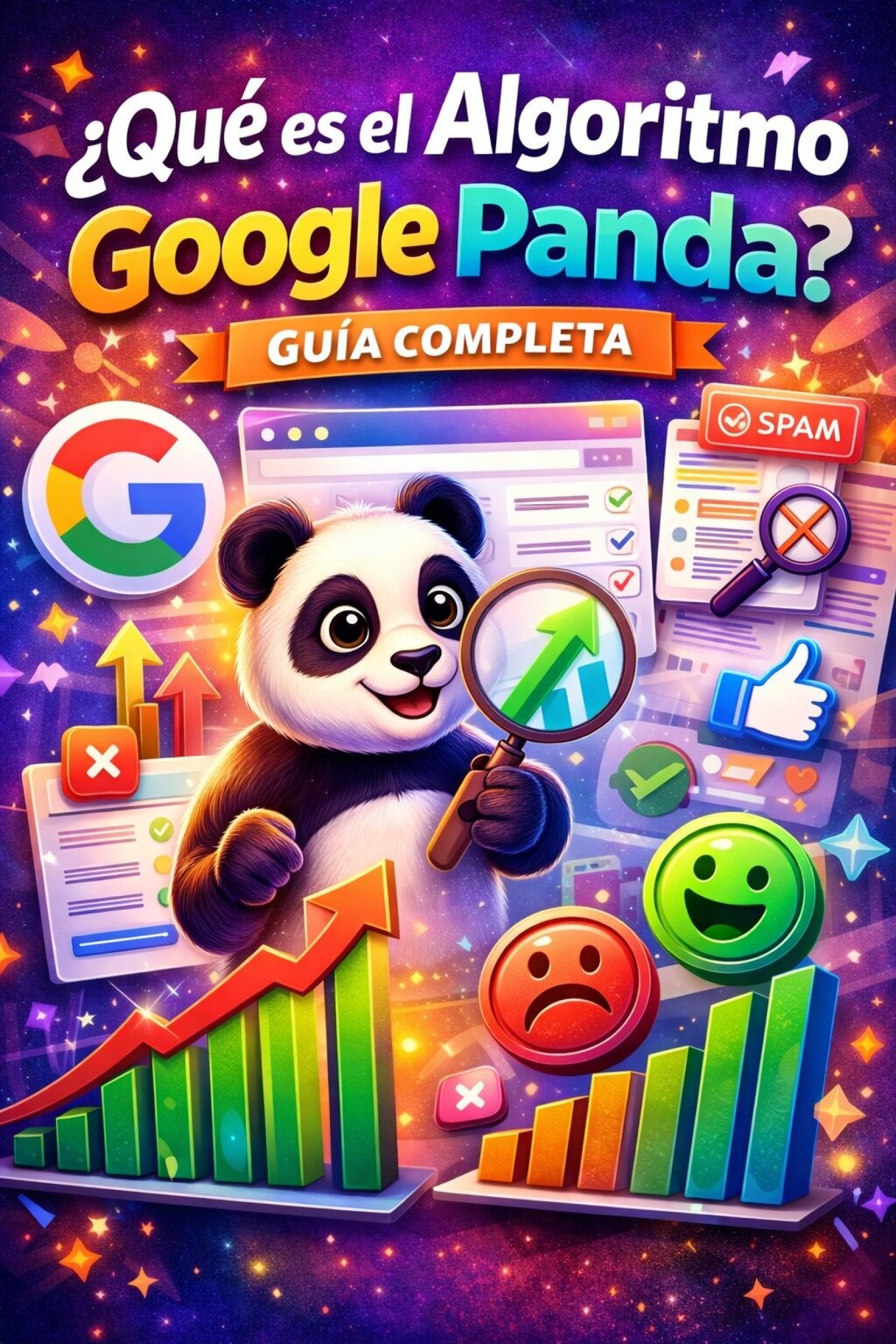
The Panda… that was indeed an earthquake. It wasn’t just another update. It was the day Google said “enough” to shortcuts and put content at the center of everything<a href="https://www.clickandclick.es/diccionario/google–panda-guia-completa/” target=”_blank” rel=”noreferrer noopener”>. If you’re in this business, understanding it isn’t an option; it’s the foundation.
What many people don’t quite grasp is that the original Panda, the one from 2011, no longer exists as such<a href="https://www.hobo-web.co.uk/google-panda/” target=”_blank” rel=”noreferrer noopener”>. It was so important that they absorbed it, turned it into the central nervous system of how Google measures quality. Now it’s something called QScore (or simply “Q”), an internal quality score at the level of your entire site. This came to light in the antitrust trials. That score is “largely static” and doesn’t depend on a specific search; it’s your website’s reputation. If that score is low, it doesn’t matter how well you optimize a page, you’ll never fly high.
And what does that system look at? The same things as always, but with more ferocity. It detests “thin” content: pages with four sentences, articles that go around in circles but say nothing, texts copied or rewritten without contributing a unique perspective. Content farms used to be built with this and it worked. Panda gave them a beating that many never recovered from. It also dislikes (and a lot) sites that are a wall of advertising, where you have to search for the content among banners.
But be careful, it’s not just a list of “don’ts.” It positively values real authority. I’m not just talking about links, but about demonstrating that you know what you’re talking about, especially on serious topics (health, finance, etc.). Google wants to see experience, expertise. It should be evident that there’s a person or team with knowledge behind it, not a robot reformulating texts.
The most revealing thing for me has always been its impact in Spain. It wasn’t theoretical. Sites like TodoExpertos or Configurarequipos saw traffic drops of 30% or more overnight. It was a brutal cleanup that proved no one was safe. It didn’t penalize individual pages; if mediocrity was the norm on your site, it dragged down the entire domain.
So, how do you adapt today? Forget about looking for “tricks for Panda.” Think about how to raise your QScore, your site’s reputation.
Do a ruthless audit. Use tools to find duplicate or shallow content on your own site. But don’t stop at the technical side. Ask yourself about each page: “Does this actually solve anything? Does it help anyone?” If the answer is “no” or “very little,” either rewrite it thoroughly with a unique and useful approach, or remove it. Having dead or filler pages weighs down your overall score.
Write for whoever reads you, not for the robot. This sounds like a cliché, but it’s the key. “Keyword stuffing” (filling with the keyword) is suicide. Go deep, be clear, structure the information well with subheadings. Imagine you’re explaining the topic to an interested colleague. That useful and direct tone is what the algorithm, ultimately, tries to identify.
Take care of the experience down to the last detail. A slow website, one that doesn’t look good on mobile or has intrusive ads, sends a clear signal that you don’t care about the user. And if you don’t care about the user, Google doesn’t care about you. Optimizing speed and having a responsive design is no longer advanced SEO; it’s the survival handbook.
In the end, what Panda (or its spirit in the QScore) did was change the rules of the game forever. We went from an era of engineering and tricks to one where the only trick that works is having no tricks: creating valuable, unique, and well-presented content. If your strategy is based on that, you won’t have to “adapt” to every update; you’ll already be at home.